iSwarm: Controlling imperfect robot swarms
A rigorous control theory to unleash and ally with imperfections, such as dropouts, delays, and scaling/biasing factors in sensors and actuators, as novel distributed control inputs for taming emergent behaviors. Our paradigm shift requires new ways of analyzing algorithms and their robot integration at the crossroads between algebraic graph theory, network theory, control, and mechatronics for multi-agent systems.
- Funding
-
 Ref 101076091
 - Partners
- Running
- 2023 - 2028
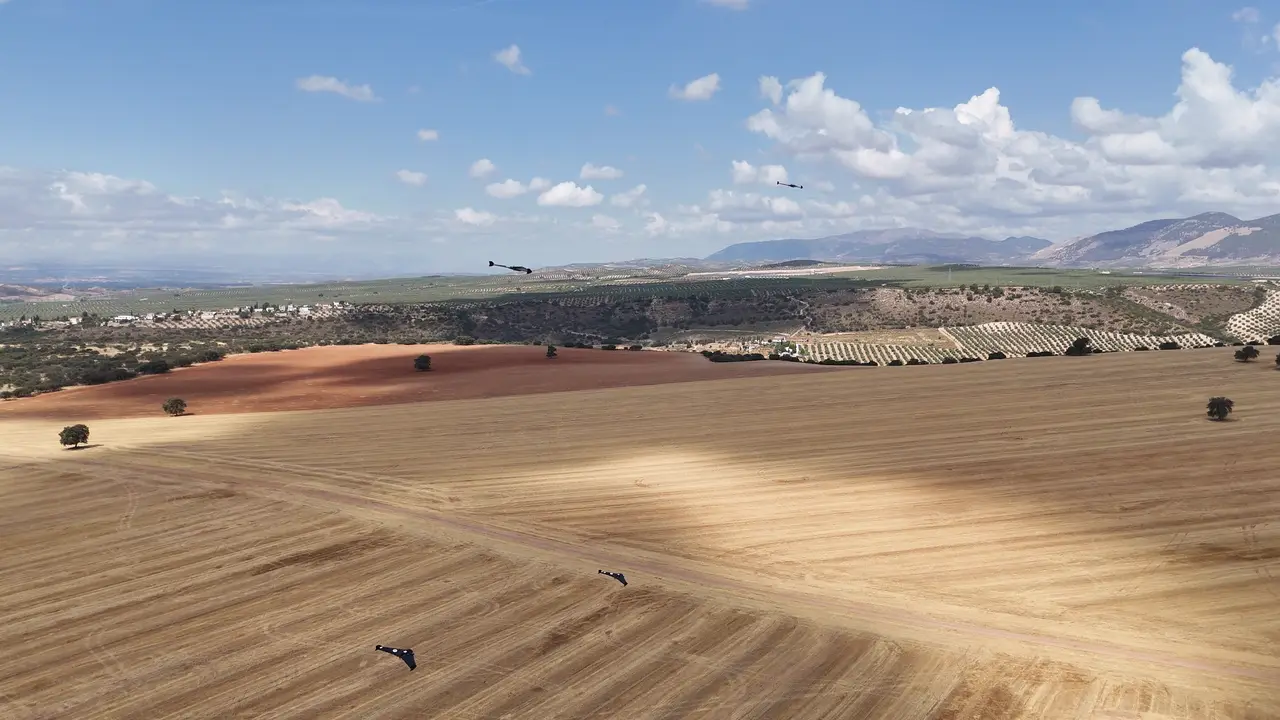
Robot swarms are incredibly fragile against imperfections. World-class roboticists agree that one of the fundamental challenges in robotics is the availability of systematic methods with formal guarantees for the design and control of the swarm’s force multiplication, where sensing, actuation, and communication are distributed in space. However, no matter the approach, control theory, or heuristic, tiny imperfections are amplified throughout large numbers of robots and rapidly erode and make unpredictable the overall performance of the swarm. Notwithstanding, imperfections can result in surprisingly complex emergent behaviors, such as intricate trajectory patterns of mobile robot swarms.
iSwarm questions the current paradigm of fighting imperfections to suppress their “damaging” effects. Conversely, we propose a rigorous control theory to unleash and ally with imperfections, such as dropouts, delays, and scaling/biasing factors in sensors and actuators, as novel distributed control inputs for taming emergent behaviors. Our paradigm shift requires new ways of analyzing algorithms and their robot integration at the crossroads between algebraic graph theory, network theory, control, and mechatronics for multi-agent systems.
To achieve the project’s goal, we will:
- Develop a general formulation to characterize the controllability and stabilizability of emergent behaviors when imperfections are treated as control inputs.
- Introduce unconventional strategies, such as mismatched Lyapunov functions, to engineer and shape emergent behaviors.
- Construct equivalence principles between imperfections and inconsistent shared information to improve the effectiveness of swarm “collective awareness” and enable more robust fault-recovery algorithms.
- Demonstrate the control of a state-of-the-art robot swarm under non-laboratory conditions by deliberately exploiting robot imperfections.
iSwarm positions imperfections not as obstacles to overcome, but as resources to exploit. By establishing the theoretical foundations and practical tools to harness imperfections, the project will inspire new research methodologies and open the door to novel applications of multi-robot systems.

Papers from this project
- [J26]
Fully distributed and resilient source seeking for robot swarms
J. Bautista, A. Acuaviva, J. Hinojosa, W. Yao, J. Castellanos, HG de Marina · IEEE Transactions on Automatic Control
- [J25]
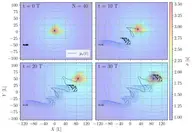
Leaderless Collective Motion in Affine Formation Control over the Complex Plane
J. Bautista, E. Morella, L. Wang, HG de Marina · IEEE Transactions on Network Systems
- [J24]
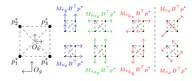
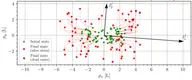
Dispersion Formation Control: from Geometry to Distribution
J. Chen, J. Bautista, B. Jayawardhana, HG de Marina · IEEE Transactions on Automatic Control
- [C42]
The distance-based formation controller design for multi-agent systems in port-Hamiltonian form
J. Zhao, Y. Wu, HG de Marina, Y. Wu · IFAC World Congress
- [C41]
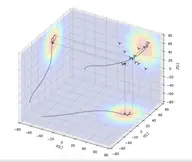
Distributed 3D Source Seeking via SO(3) Geometric Control of Robot Swarms
J. Bautista, and HG de Marina · IFAC World Congress
- [C39]
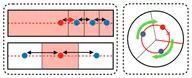
Voronoi-Based Area Coverage Algorithms: Turning Real-World Fragility into Strength
J. Bosco, E. Morellà, O. Arslan, HG de Marina · IEEE International Symposium on Multi-Robot and Multi-Agent Systems (MRS)
- [C38]
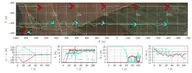
Distributed Oscillatory Guidance for Formation Flight of Fixed-Wing Drones
Y. Xu, J. Bautista, J. Hinojosa, HG de Marina · IEEE/RSJ International Conference on Intelligent Robots and Systems (IROS)
- [C36]
Inverse Kinematics on Guiding Vector Fields for Robot Path Following
Y. Zhou, J. Bautista, W. Yao, and HG de Marina · IEEE International Conference on Robotics and Automation (ICRA)